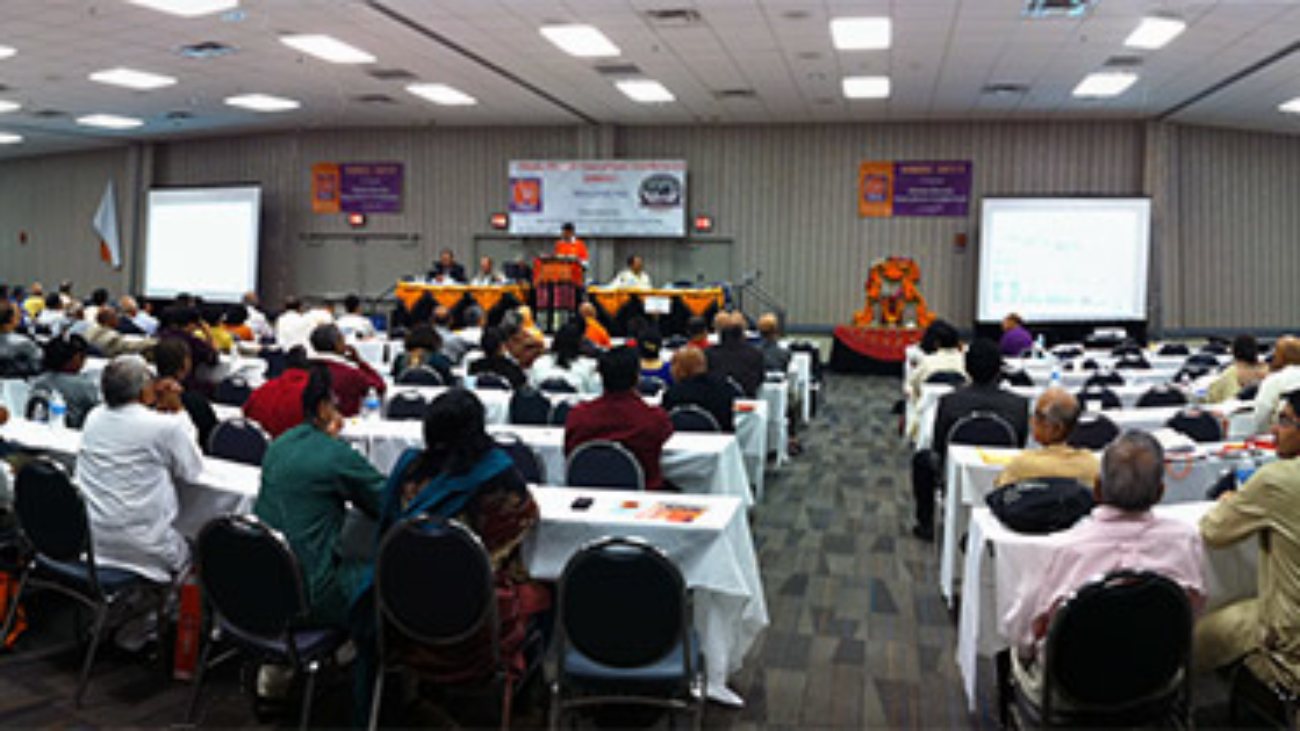
hmec

Hindus in USA hold a virtual collective prayer for the ‘Shree Ram Mandir Poojan’

As the Ayodhya administration in India was getting ready for the foundation laying ceremony of the Lord Ram temple on Wednesday, August 5, the Hindu Mandir Executives’ Conference (HMEC) and Hindu Mandir Priests’ Conference (HMPC) held a virtual collective national prayer across America to rejoice in the upcoming “Shree Ram Mandir Poojan” at Ayodhya.

The Vishwa Hindu Parishad of America organized the prayer to mark Wednesday’s ceremony, a one-of-a-kind and historic event on 5th August in Ayodhya, when Prime Minister Prime Minister Narendra Modi will be worshiping with revered saints, scholars, trustees and other dignitaries for the grand Janmabhoomi temple of Bhagwan Shri Ram.

Gaurang Vaishnav, Member Advisory Board of World Hindu Council of America (VHPA), Tampa FL, said: “August 5, 2020 will be written in golden letters in the history of Bharat (India) and Hindus. This is the day when after a long wait of 492 years, construction of a grand Shri Ram Mandir will begin at his birthplace in Ayodhya. I recall with joy the efforts of VHP in Bharat and elsewhere, to bring Hindus together to fight for what was theirs and was taken by the invaders. My hearty congratulations to not only all Hindus but also to those who respect and cherish the culture, heritage and unity of Bharat.”

On this occasion of the fulfilment of the aspirations of the Rama Mandir, executives and the Mandir priests across USA, Canada and Caribbean Islands join in offering on the eve of the Ram Mandir reconstruction poojan.

“With utmost reverence, I remember two great personalities, Shree Ashok Singhal and Pujya Mahant Shree Avaidynath, who are no longer with us, but whose vision, sacrifice, determination, leadership, blessings and resolve has made this dream of the reconstruction of the Ram Mandir in Ayodhya a reality. For a joyful global Hindu community, the historic ceremony on Aug 5, 2020, marks the ushering of a new era. We should cherish and celebrate this day as a festival now, and forever in the future,” said Pandit Krishna Kumar Pandey, founder, president and Acharya of the Shiv Durga Temple, Bay Area, CA

A collective chanting of the Ram Raksha Stotra and Sri Ram Naam chanting by priests in the USA, Canada, and the Caribbean Islands was held at 7.00 pm (CST)/ 8.00 pm (EST)/ 5.00 pm (PST), followed by a Bhajan rendered by renowned playback singers Sanjeevani Bhelande & Anup Jalota from 7.30 pm (CST)/ 8.30 pm (EST)/ 5.30 pm (PST) on Tuesday, August 4.

The live streaming can be viewed on YouTube at youtube.com/user/gayatrivideo or Facebook at facebook.com/VHPAmerica.org.

The Vishwa Hindu Parishad of America (VHPA) will host the Facebook live stream of the August 5 program of foundation laying of Shree Ram Mandir by Prime Minister Narendra Modi at 1.30 am (CST)/ 2.30 am (EST)/ 11.30 pm (PST).

PTI01-08-2020_000197A_1596517197982_1596517233652

Indian-Americans to celebrate Ram Temple foundation laying ceremony

  • The groundbreaking ceremony for the construction of the temple would take place on August 5 in Ayodhya
  • Prime Minister Narendra Modi would be attending the event

Washington: Temples across the US have announced special events to celebrate the foundation laying ceremony of the historic Ram Temple in Ayodhya, with a tableau truck displaying digital images of the Ram Temple going around the US Capitol Hill on Tuesday, according to Hindu community leaders.

The groundbreaking ceremony for the construction of the temple would take place on August 5 in the holy town of Ayodhya and Prime Minister Narendra Modi would be attending the event. Temples across the US will perform special poojas and prayers, while a large number of Indian-Americans have said that they would lit diya to celebrate the bhoomi poojan of the Ram Temple.

77296907

Temples in North America to hold virtual prayer to celebrate Ram Temple’s foundation laying ceremony

WASHINGTON: temples in North America will hold a virtual national prayer to celebrate the foundation laying of the Ram Temple in Ayodhya, religious groups have announced.

The Hindu Mandir Executives’ Conference (HMEC) and the Hindu Mandir Priests’ Conference (HMPC), in a statement on Friday, called for a virtual collective national prayer across America to rejoice the upcoming “Shree Ram Mandir Poojan” at Ayodhya.

On the auspicious occasion, the temples across the US, Canada and Caribbean Islands will join in offering seva (service) in the “Lotus feet” of Lord Rama on the eve of the Ram Mandir reconstruction poojan (prayer), the statement said.

“For a joyful global Hindu community, the historic ceremony on August 5, 2020, marks the ushering of a new era. We should cherish and celebrate this day as a festival now, and forever in the future,” said Pandit Krishna Kumar Pandey, founder, president and Acharya of the Shiv Durga Temple in Bay Area, California.

said it is organising prayers to mark the August 5 ceremony in Ayodhya, when Prime Minister Narendra Modi will be laying the foundation stone of the temple.

A collective chanting by priests in North America will be held, followed by a devotional song by playback singers Anup Jalota and Sanjeevani Bhelande.

Temples in North America to hold virtual prayer to celebrate Ram Temple’s foundation laying ceremony

Washington: Hindu temples in North America will hold a virtual national prayer to celebrate the foundation laying ceremony of the Ram Temple in Ayodhya, religious groups have announced.

The Hindu Mandir Executives’ Conference (HMEC) and the Hindu Mandir Priests’ Conference (HMPC), in a statement on Friday, called for a virtual collective national prayer across America to rejoice the upcoming “Shree Ram Mandir Poojan” at Ayodhya.

On the auspicious occasion, the temples across the US, Canada and Caribbean Islands will join in offering seva (service) in the “Lotus feet” of Lord Rama on the eve of the Ram Mandir reconstruction poojan (prayer), the statement said.

“For a joyful global Hindu community, the historic ceremony on August 5, 2020, marks the ushering of a new era. We should cherish and celebrate this day as a festival now, and forever in the future,” said Pandit Krishna Kumar Pandey, founder, president and Acharya of the Shiv Durga Temple in Bay Area, California.

Vishwa Hindu Parishad of America said it is organising prayers to mark the August 5 ceremony in Ayodhya, when Prime Minister Narendra Modi will be laying the foundation stone of the temple.

A collective chanting by priests in North America will be held, followed by a devotional song by playback singers Anup Jalota and Sanjeevani Bhelande.

The-Hindu-Temple-Executives-Conference-HMEC

Online national prayer will be held on the occasion of Ayodhya land worship in America

Washington: On August 1, on the occasion of Bhumi Pujan for the construction of Ram temple in Ayodhya, online national prayer will be organized in Hindu temples of North America. Religious groups gave this information. The Hindu Temple Executives Conference (HMEC) and the Hindu Temple Priests Conference (HMPC) issued a statement on Friday, calling for a national prayer to be held simultaneously across the US on the occasion of “Shri Ram Mandir Bhoomi Pujan” to be held in Ayodhya.


It said that on this auspicious occasion, temples of America, Canada, and Caribbean islands will serve in the ‘Charankamal’ of Lord Rama on the eve of worship. Pandit Krishna Kumar Pandey, Founder, President, and Acharya of Shiva Durga Temple in Bay Area of ​​California said, “The historic celebration of August 5, 2020 is the beginning of a new era for the global Hindu community. We should celebrate this day as a festival from now on. ” In the US, the Vishwa Hindu Parishad said that prayers will be held on August 5, when Prime Minister Narendra Modi will lay the foundation stone of the temple in Ayodhya. There will be mass chanting in North America, after which the hymns of Anoop Jalota and Sanjeevani Bhelande will be heard.

Ganesha-Temple-in-North-America

Temples in N America to hold virtual prayer to celebrate Ram Temple’s foundation laying ceremony

Hindu temples in North America will hold a virtual national prayer to celebrate the foundation laying ceremony of the Ram Temple in Ayodhya, religious groups have announced.

The Hindu Mandir Executives’ Conference (HMEC) and the Hindu Mandir Priests’ Conference (HMPC), in a statement on Friday, called for a virtual collective national prayer across America to rejoice the upcoming “Shree Ram Mandir Poojan” at Ayodhya.


On the auspicious occasion, the temples across the US, Canada and Caribbean Islands will join in offering seva (service) in the “Lotus feet” of Lord Rama on the eve of the Ram Mandir reconstruction poojan (prayer), the statement said.

“For a joyful global Hindu community, the historic ceremony on August 5, 2020, marks the ushering of a new era. We should cherish and celebrate this day as a festival now, and forever in the future,” said Pandit Krishna Kumar Pandey, founder, president and  of the Shiv Durga Temple in Bay Area, California.

Vishwa Hindu Parishad of America said it is organising prayers to mark the August 5 ceremony in Ayodhya, when Prime Minister Narendra Modi will be laying the foundation stone of the temple.

A collective chanting by priests in North America will be held, followed by a devotional song by playback singers Anup Jalota and Sanjeevani Bhelande.

swarajya_2020-06_5720068e-d4d8-4a30-913f-ffc68cf8fba0_4e5fa9f37e98e4644049e945ed5a3cea

Ayodhya Ram Mandir Bhumi Pujan: Hindu Temples In North America To Hold Virtual Prayers To Celebrate The Historic Event

A virtual national prayer will be held at the Hindu temples in North America to celebrate the ‘bhumi pujan’ ceremony of Shri Ram Temple in Ayodhya on 5 August, Hindu religious groups have announced, reports Times of India.

In a statement on Friday (31 July), the Hindu Mandir Priests’ Conference (HMPC) and the Hindu Mandir Executives’ Conference (HMPC) called for a virtual collective national prayer across America to celebrate the Shri Ram Mandir Bhumi Pujan at Ayodhya.

On the auspicious occasion, the temples across the US, Canada and Caribbean Islands will join in offering seva (service) in the “Lotus feet” of Lord Rama on the eve of the Ram Mandir reconstruction poojan (prayer), the statement said.

“For a joyful global Hindu community, the historic ceremony on August 5, 2020, marks the ushering of a new era. We should cherish and celebrate this day as a festival now, and forever in the future,” Pandit Krishna Kumar Pandey, founder, president and Acharya of the Shiv Durga Temple in Bay Area, California was quoted as saying.

It should be noted that Prime Minister Narendra Modi will be participating in the Ram Mandir Bhumi Pujan ceremony in Ayodhya on 5 August.

Vishwa Parishad of America said that it will be organising prayers across the North America to mark the historic occasion. A collective chanting by priests in North America will be held, followed by a devotional song by singers Anup Jalota and Sanjeevani Bhelande.

1595824050_untitled-design-2020-07-27t095536.745

Temples in N America to Hold Virtual Prayer to Celebrate Ram Temple’s Foundation Laying Ceremony

Hindu temples in North America will hold a virtual national prayer to celebrate the foundation laying ceremony of the Ram Temple in Ayodhya, religious groups have announced.

The Hindu Mandir Executives’ Conference (HMEC) and the Hindu Mandir Priests’ Conference (HMPC), in a statement on Friday, called for a virtual collective national prayer across America to rejoice the upcoming “Shree Ram Mandir Poojan” at Ayodhya. On the auspicious occasion, the temples across the US, Canada and Caribbean Islands will join in offering seva (service) in the “Lotus feet” of Lord Rama on the eve of the Ram Mandir reconstruction poojan (prayer), the statement said.

“For a joyful global Hindu community, the historic ceremony on August 5, 2020, marks the ushering of a new era. We should cherish and celebrate this day as a festival now, and forever in the future,” said Pandit Krishna Kumar Pandey, founder, president and Acharya of the Shiv Durga Temple in Bay Area, California. Vishwa Hindu Parishad of America said it is organising prayers to mark the August 5 ceremony in Ayodhya, when Prime Minister Narendra Modi will be laying the foundation stone of the temple.

A collective chanting by priests in North America will be held, followed by a devotional song by playback singers Anup Jalota and Sanjeevani Bhelande.

hmec

Temples in North America to hold virtual prayer to celebrate Ram Temple’s foundation laying ceremony

Washington: Hindu temples in North America will hold a virtual national prayer to celebrate the foundation laying ceremony of the Ram Temple in Ayodhya, religious groups have announced.

The Hindu Mandir Executives’ Conference (HMEC) and the Hindu Mandir Priests’ Conference (HMPC), in a statement on Friday, called for a virtual collective national prayer across America to rejoice the upcoming “Shree Ram Mandir Poojan” at Ayodhya.

On the auspicious occasion, the temples across the US, Canada and Caribbean Islands will join in offering seva (service) in the “Lotus feet” of Lord Rama on the eve of the Ram Mandir reconstruction poojan (prayer), the statement said.

“For a joyful global Hindu community, the historic ceremony on August 5, 2020, marks the ushering of a new era. We should cherish and celebrate this day as a festival now, and forever in the future,” said Pandit Krishna Kumar Pandey, founder, president and Acharya of the Shiv Durga Temple in Bay Area, California.

Vishwa Hindu Parishad of America said it is organising prayers to mark the August 5 ceremony in Ayodhya, when Prime Minister Narendra Modi will be laying the foundation stone of the temple.

A collective chanting by priests in North America will be held, followed by a devotional song by playback singers Anup Jalota and Sanjeevani Bhelande.

2_01_16_25_ram_1_H@@IGHT_1035_W@@IDTH_800

Hindus in USA to celebrate historic ‘Shree Ram Mandir poojan

USA, July 31: The reverberations of August 5, 2020, foundation laying ceremony of Sri Ram Mandir at Ayodhya in Bharat, are visible in the far-off USA. Here the Hindu Mandir Executives’ Committee (HMEC) and Hindu Mandir Priests’ Conference (HMPC) have organized a virtual collective national prayer across the USA to rejoice in the historic “Shree Ram Mandir Poojan in Ayodhya”.

A joint press release issued by HEMC and HMPC said that invitation to all the Mandir Executives and Mandir Priests across the USA, Canada, and the Caribbean Islands are invited to take part in VIRTUAL Samuhik (Collective) Chanting and offer our Seva at the Lotus feet of Prabhu Shree Ram on the eve of Shree Ram Mandir reconstruction poojan.

The HEMC and HMPC offered pranams to Dharma Gurus, all the devotees whose tyag and tapas and the grace of Shree Ram have brought this Dharmic Movement to a historic milestone – a dream come true.

The program includes Collective chanting of Ramraksha stotra and Sri Ram Naam chanting by priests in the USA, Canada, and the Caribbean Islands followed by Bhajan by renowned playback singers Sanjeevani Bhelande & Anup Jalota. Meanwhile, the Vishwa Hindu Parishad of America (VHPA) will make llive telecast of the August 5 program of foundation laying of Shree Ram Mandir which will be performed by Prime Minister Narendra Modi.

Hindu_Mandir_Priest_Conference2-e1535465882873-1

Vishwa Hindu Parishad’s enlightening 7th Hindu Mandir Priests’ conference held in Atlanta

Atlanta, GA, August 28, 2018: Vishwa Hindu Parishad of America organized its Dharma Sansad, 7th Hindu Mandir Priests Conference, a part of Hindu Mandir Executive Conference, at the Global Mall, Norcross, Georgia on 20th and 21st July, 2018. The theme of the well-attended and inspiring conference was ‘Dharmo rakshati rakshitah’ (Dharma protects those who uphold or protect dharma). The Conference was hosted by Pundit Gyan Prakash Upadhyay of Siddhi Vinayak Mandir, in Global Mall and co-hosted by Ambaji USA Shri Shakti Mandir; Hindu Temple of Atlanta; Sankat Mochan Hanuman Mandir; Sri Hanuman Mandir, Alpharetta; Gokuldham; Sanatan Mandir; BAPS Shri Swaminarayan Mandir; Hindu Temple and Cultural Center of South Carolina. The Conference was graced by the respected and learned priests, scholars of Hindu Religion; community dignitaries Sanjay Mehta;Laxmi Bhamidipati; Smt.Tejal;Dr.Sujatha Reddy; Chandra Reddy; Shiv Aggarwal;Kusum and Sudarshan Khurana;Veena and Madhav Katdare;Shyam and Manjula Tiwari;Vasav and Sneha Mehta;Swadesh Katoch;Vikas Arora; Amit Khurana; Tarun Sirohi; Ashwini Jindal; Sunit Deshwal; Vijay Patel; Seema Garg; Manoj Bhatia; Sridhatr,VHP Officials and volunteers. The learned priests and scholars shared many insights and enlightening nuggets of wisdom on Hindu religion over the two-day discourses and talks. The common thread was the need to lead an upright and religious life. In keeping with the theme; “If we follow our religion and lead a religious life and protect our religion, then our religion will safeguard us.”

Since 2015, at each Hindu Mandir Priest’s Conference,’Archaka Bhushana’Award is being conferred to distinguished priests to honor their significant and sustained spiritual and social services to the Hindu community. This year the awardees were: Sri Venkata Pidaparthi; Sri Naimishkumar Joshi; Sri Narasimha Cherukapalli; Sri Pramod Padhi; Sri Chakrapani Kumara; Sri Mukti Prasad Kafle; Sri Narayana Bhatter; Sri Sandip Thaker; Sri Pavan Kumar Kristapati; and Pundit Gyan Prakash Upadhyay.

On the concluding day, Pundit Gyan Prakash ji gave a riveting talk on meaning of Dhrma, different kinds of dharmas, and Sanatan dharma (unchanging and abiding principles of dharma).He said that dharma encompasses more than rituals. It includes duties, rights, and righteous living. One must carry out one’s duties in family, society or nation in a morally, upright way to ensure peace and harmony for all.

Screenshot-2019-08-31-at-10.22.32-AM

Hindu Students Council goes to HMEC

Several members of Hindu Students Council’s National Leadership team attended and spoke at the recently concluded Hindu Mandir Executives’ Conference (HMEC), in Indianapolis. The annual conference, which spanned the weekend of September 17- 19, is organized by the Vishwa Hindu Parishad of America (VHP-A) and aims to help mandirs connect with each other and dialogue on several important issues. This year, the theme of the conference—the Digital Mandir—lent itself crucially to a strong youth presence, and HSC members spoke and participated in dynamic ways.

Treasurer Sohini Sircar and General Secretary Parth Parihar, along with members of the Coalition of Hindu Youth (CHY), helped to coordinate youth sessions related to bettering the ways in which mandirs can harness social media to better reach a youth demographic. Today, in many mandirs, the faces that populate the worshippers are often those of the first-generation that arrived here decades ago. Their children have grown disconnected from their Hindu roots. HSC leader Riddhi Patel underscored that even when younger children attend, they often do so at the behest of their parents, and don’t have an inherent stake in the mandir or the community.

Here, HSC plays and can continue to help play a crucial role. This is precisely the topic that HSC President Ravindra Jaishankar addressed in his plenary talk on Saturday, calling on mandir leaders to diversify programming and services to attract youth. Jaishankar proposed SAT tutoring, classical dance and music, along with a host of other programs that could be harnessed to deliver what the Hindu youth of today is looking for, transforming the mandir into a community hub.

As Parihar pointed out, HSC’s presence on social media remains a vital connection for youth throughout the country, as it is the Hindu American organization with the largest reach on Facebook and is transitioning into other fora like Instagram and Twitter. The presentation Parihar delivered on the misrepresentation of Hinduism in Western education was in the form of a YouTube video to make content generated through HMEC easily accessible to participants outside the venue. Sircar helped formulate a ‘Digital Guide’ for mandirs that is a user-friendly list of “do’s” and “don’ts” that will help shape the ways mandirs reach out to a youth base.

HSC leaders Venkat Ganesh and Riddhi Patel helped shape the discussion during the youth session and enthusiastically networked with others throughout the duration of conference. Said Ganesh of his first HMEC experience, “HMEC 2017 was a memorable first for me. I had the opportunity to meetup with many like-minded, young followers of Dharmic traditions (and celebrate Ravi’s birthday with my HSC friends!). Representing HSC at the event, it gave me a platform to share the work that our organization was doing across different campuses in the country. I enjoyed discussions at the youth session where one of the topics was – how to engage the youth to be more involved in temple activities and leverage social media platforms to stay connected with the local temple. It was pleasing to see active participation and good suggestions put forward by the young group. Also having Aarti at the HTCI temple and subsequent live music-dance performances gave a nice touch to the event. Overall, the event was well planned out and I look forward to attending it next year”.

Through its pool of dedicated leaders, Hindu Students Council hopes to continue to have a strong presence at future HMEC’s and contribute to this very noble effort to uplift Hindu dharma for the next generation.

Hindu Temple of The Woodlands hosts Hindu Temple Priests’ Conference

Hindu Temple of The Woodlands (HTW) hosted the 6th Annual Hindu Mandir Priests’ Conference at its beautiful temple in its far northern suburb of greater Houston on July 14 and 15.

Priests from as far away as Minnesota and Massachusetts participated in the conference along with priests, community members, and youth from the greater Houston area and elsewhere in Texas and the USA.

The conference was initiated six years ago by World Hindu Council of America (VHP-A) as a part of the Hindu Mandir Executive Conference.

This year’s theme was “Temple’s Role in Educating Our Youth in Spirituality”.

The vision of the conference was to promote the sustainability and advancement of Sanatana Dharma by making Hindu modes of worship meaningful and relevant for the younger generation of Hindus.


To help the priests attending the conference to better understand the needs of the children, teens, and young adults, a number of local youth volunteers had the opportunity to ask questions of the priests in an open session, as well as provide suggestions as to how their needs can be better met by the priests and the mandirs.

The youth wanted to know what importance the precise dates and times for various events had and what the consequences for not following those were. Others wondered why they should wear traditional Hindu dress when visiting the temple. In response to a question about whether daily prayer is important, one of the priests, stating that it was important, also indicated that even taking two or three minutes for prayer before leaving home and starting the daily routine would be beneficial.

Several of the attendees mentioned the fact that many of the priests are not proficient in English is an impediment for priests and youth to communicate directly. A number felt it was appropriate for temples to provide opportunities for priests to learn English while others were of the view that also the children should be taught their “mother tongue” at home by parents so that communication with priests might be in an Indian language. A number of temples, including HTW, also offer language classes for children and youth.

Teaching the basics of Sanatana Dharma and its practices by parents and well as in various temple classes was also emphasized by a number of attendees and implemented in many temples. Many of the priests insert a few sentences in English about the various steps of the rituals as they were performed, feeling it was beneficial to all devotees, not just to the youth.

Other sessions of the conference provided opportunity for the priests to learn about the challenges found in various mandirs and ways in which the challenges were met. The priests, other attendees, and youth all benefited from their interactions and proposals by some of the speakers including representatives of VHP of America and Hindu University of America who are jointly developing an online chaplaincy certification program.

All the attendees appreciated the hospitality of the host temple. One of the attendees “complained” that the food was so tasty he over-ate! Others were very impressed that the temple volunteers prepared all the food and did not have it catered. The opportunity to prepare the food while chatting and enjoying the comradery was an added benefit for the volunteers themselves.

Other volunteers helped with logistics, program planning and scheduling, overnight hosting of the priests, and more. HTW has become known as a temple with a very strong volunteer base and a commitment to service to the community.

Both the planned chanting by the priests as a group at the beginning of the conference and Saturday morning, as well as the spontaneous group chanting, gave a very special atmosphere to the conference. One of the community workers who attended mentioned how great it was to be in the presence of all the priests from the various temples receiving blessings from them all on his birthday!

A special feature of the conference was the honoring of the priests with twenty or more years of experience as priests in America with the Archaka Bhushana Award. In addition, all the presenters and all the priests attending were recognized.

The conference’s success was due in large part to the cooperative efforts of the World Hindu Council of America (VHP America) and HTW. Volunteer leadership and interest of the priests and community members, including youth, helped make it a success that other temples and communities will strive to emulate.

The Hindu Temple of The Woodlands was pleased to host this conference. Hindus of Greater Houston, sponsors of the first community-wide Krishna Janmashtami celebration in North America, generously donated to HTW to help meet the expenses of the conference. Jagan Allam, Chairperson, and Mukesh Mittal, President, gratefully accepted the check.

The Hindu Temple of The Woodlands is located at 7601 S Forestgate Drive, just off Woodlands Parkway, in The Woodlands (Spring), TX 77382.

Established in 2005 and inaugurated in 2011, it serves the religious, cultural, educational, and social needs of the surrounding community. It also provides services, such as five free yoga classes per week to non-Hindu neighbors and donations of food, clothing, and other items to the less fortunate through local non-profit agencies.

More information is on the temple’s website, www.woodlandshindutemple.org.

5th Hindu Mandir Priests’ Conference (HMPC)

Montclair, CA. The 5th Annual Hindu Mandir Priests’ Conference was held on 24th & 25th June at Nithyanandeshwara Hindu Temple, Los Angeles Aadheenam on future of North American Hindu Priests.

Delegates from Hindu mandirs and organizations from all over North America, especially Southern California, participated and has been focusing on creating a platform for Priests, Management and Devotees to enhance the services offered at the Mandir. The conference served as a Hindu think-tank to deliberate on issues faced by priests, and sought to empower them to become spiritual activists of the community.

The evening started with Arati. In her welcome address Ma Nithya Mukthikananda, Mahanth of Mahanirvani Akhada and coordinator of the host temple, stressed the importance of the priests in the Hindu community not only for the rituals they conduct but also for the ‘Jnana, Space and Presence’ they share with the community. Supporting them means supporting our temples.

In his opening address, Dr. Abhaya Asthana, President of VHPA raised a thought provoking question: ‘What will be the legacy of Hindu Americans hundreds of years from now?’ and offered hope that the Hindu community will be known for bringing spiritual transformation to North America. He described how temples are the vehicles of this change, emphasized the importance of supporting our priests and highlighted what can happen if we don’t—citing an example of a U.S. priest who has been in the country for more than 40 years but has not experienced growth since leaving India.

Prominent Hindu leaders, and highly respected priests delivered keynote addresses. Swami Adrishananda of Sri Nand Shiv Durga temple, Montebello said that temple is where spiritual awakening starts, as spiritual food is

offered at the temple. Pt Roopnauth Sharma of Mississauga Ram Mandir, Canada in his video address said, priests are the conduits of the connection between the individual and God and need to constantly update themselves. Sri Narasimmacharya Cherukupally of Panchamukha Hanuman Temple, Torrance said it’s important to consider that priests need challenge and expansion.

In a special address, His Holiness Paramahamsa Sri Nithyananda Swami, Mahamandaleshwar of Mahanirvani Akhada, stressed the importance of developing the right inner and outer image for Hindus worldwide. He added, the Spiritual legitimacy for Sanatana Hindu Dharma can be brought about by living the agamas, making the yogic and vedic sciences as a reality (rather than just a theory), and expressing the powers described in them we can build the right inner image. This is directly relevant to the priests since they are in the best position to make this happen.

The informative workshops on the second day offered practical learning modules designed to empower priests with skills for effective communication and community engagement. The sessions covered a variety of topics including the importance of participation of priests in

interfaith events, importance of continuing education and growth for priests, importance of youth involvement in priesthood, legalities that priests should be aware of during marriage counseling, etc.

Delegates from various organizations including, Swami Narayan Mandir, Brahman Samaj of N.A., Lakshmi Narayan Mandir, Riverside, Irvine Mandir, Vedanta Society of Los Angeles, Ekal Foundation, Indic Foundation, Param Shakti Peeth of America, Pasadena Durga Temple, Claremont School of Theology, Nithyanandeshwara Hindu Temple, Ohio, Nithyanandeshwara Hindu Temple, Phoenix and Nithyanandeshwara Hindu Temple, Seattle participated and shared their experience.

The program concluded with a unique forum where priests, temple executives and devotees formed focus groups and brought forth their honest perspectives and solutions in creating a thriving dharmic ecosystem for mandirs. In his closing address, the Sri Mahant of Mahanirvani Akhada

Sri Nithya Mukthananda said that Hindu temples should be universities, and centers for cultural revolution. He concluded with the vision that priests will become the center of this cultural revolution.

Hindu Mandir Priests’ Conference (HMPC) is an initiative of the World Hindu Council of America (VHPA).

hmec

Fourth Nationwide Hindu Mandir priest Conference Held in Minnesota

More than 55 pundits, adults, and youth delegates representing temples and Hindu organizations across the nation attended the fourth Hindu Mandir Priests’ Conference (HMPC), an initiative of Hindu Mandir Executives’ Conference (HMEC) that was hosted by Hindu Temple of Minnesota (HTM), Maple Grove, Minnesota, May 15 through 16. Its four sessions on role and relationship of priests, sustaining Hindu temples, community links and Hindu-American youth viewpoint. Professor Anant Rambachan from St. Olaf College, Minnesota, delivered the keynote address on the second day.

Following lamp lighting and Vedic chanting, HTM religious committee chairman Raj Suryanarayanan delivered the welcome address and set the conference goals and objectives. Chief priest of Ram Mandir of Mississauga, Canada, Pundit Roopnauth Sharma, delivered the keynote on “Hinduism for the new age” that highlighted the need for consistency in communication by the priests and for congregational temple worship.

HTM founding trustee Dr. Shashikant Sane summarized the session by emphasizing the need to establish educational programs in temples, learning from positive communication practices, interfaith dialog and fundraising.

Vishal Agarwal shared the teaching curriculum used for 350 students of Hindu American Temple School (HATS) over the past five years and displayed all the teaching materials to be made available soon in e-book format.

HTM religious committee trustees and past chairs Raj and Anandi Balasubramanian coordinated the two sessions dedicated to the priests. All the HTM priests presented along with several from other Minnesota temples. HTM chief priest Pt. Ronur Murali Bhattar emphasized that priests should be tolerant toward devotees and conduct worship with utmost devotion.

Young mother and devotee Vallabha Tantry expressed the need to inspire the younger generation to choose the profession of temple priest. Pt. Gowtham Narayan described the role of Vedic chanting in temples and gave a practical demonstration. Parthan Gomadam elaborated on similarities between Sanskrit and Tamil in Vaishnava worship. Bhattar’s wife, Nagalatha Murali summarized the shared experiences of the wives of the HTM priests in balancing their religious lifestyle with the American cultural environment. She praised the support that priest families receive from devotees.

“Challenge our new generation of Hindus may face is not so much attraction toward other religions but becoming less interested in their own traditions,” said Rambachan in his second-day keynote.

Expressing joy at her adopted son from India attending HATS, Annette Kurek demonstrated how stories told thorough puppet shows can deliver powerful moral messages to children attending temple youth programs. Padmakumar of Sanskrit Bharati, California, spoke in Sanskrit and highlighted its significance and the value of learning the language. Attorney Harsh Voruganti of Hindu American Foundation, Virginia, spoke of temple safety and security requirements and shared HAF’s published guidelines.

The conference established the precedent of honoring distinguished senior priests for dedicated service to the Hindu community for more than two decades, by conferring the title of “Archaka Bhushana” (Priestly Ornament). Koteshwaran Gurukkal from Ganesh Temple, Nashville, Tennessee, Krishnarajan Devarajan from Hindu Temple of Greater Chicago, Lemont, Illinois, and S. Venkatacharyulu of Sri Venkateswara Temple, Pittsburgh, Pennsylvania, were the recipients of the 2015 award. Kandamangalam Gopala Deekshidhar was recognized for his service to HTM.

Sanjay Mehta of Pittsburgh concluded by summarizing actionable items: mechanism for constant communication amongst temple management and priests to share experiences and best practices; English language and communication workshops for priests; a short manual of common consistent answers delivered by priests to temple visitors; and a think tank to define and build a forward-looking priests development program.

HMEC provides leadership to Hindu-American communities by encouraging temples across North America to protect and sustain Hindu Dharma. HMPC is an initiative of World Hindu Council of America (VHPA).

HMPC-Group2-1024x678

The 4th Hindu Mandir Priest Conference (HMPC) held in Minnesota, MN

Hindu Mandir Priests’Conference (HMPC)is an initiative of theHindu Mandir Executives’ Conference. The mission of HMEC is to provide leadership to the Hindu-American community by encouraging Hindu temples across North America to nourish, protect, and sustain Hindu Dharma.The 4th annual HMPC was hosted by Hindu Temple of Minnesota, MN from May 15–16, 2015.

This year, over 55 pundits, adults, and youth delegates attended this conference, representing various Mandirs and Hindu organizations across the nation. The conference was organized into 4sessions, and the topics were consistent with the HMPC’s objective: Sustainability and Advancement of Sanatana Dharma by making the modes of worship meaningful and relevant for the younger generation of Hindus. The four sessions were: Role and relationship of Priests, Sustaining Hindu temples, Community links, and Hindu American Youth viewpoint.

The program began with a Deep Prajjwalan and Vedic chanting led by all priests in attendance.Raj Suryanarayanan,the religious committee chairperson of MN Hindu Temple, delivered the welcome address and set the conference goalsand objectives.

Pundit Roopnauth Sharma, Chief Priest ofRam Mandir of Mississauga, Canada, delivered the keynote address on‘Hinduism for the new age’. He highlighted the importance of consistency of messages translated by the priests. He also emphasized the need of samuhik (congregational) worship in the temples.

Dr. Shashikant Sane, afounding trustee of MN Hindu Temple, summarized the session by emphasizing the need to establish strong educational programs in the temples, learning from positive practices of communication, interfaith dialog and Fund raising from each other from the entire temple community and implementthose positive things in our respective temples.

Mr. Vishal Agarwal shared the teaching curriculum used for 350 Students of Hindu American Temple School (HATS) over the past 5 years and displayed all the teaching material for everyone. That material would be available in e-book format in the coming months.

Shri Raj Balasubramanian and ShrimatiAnandiBalasubramanian, trustees and past chairs of the Religious Committee of Hindu Temple of MN, coordinated the two sessions dedicated to the priests. There were presentations by all the priests from the Hindu Temple of MN and by several priests from the other MN temples. Pt. Murali Bhattar, Chief Priest of MN Hindu Temple, emphasized that the priests need to be tolerant towards devotees and priestsshould worship with utmost devotion for the benefit of the entire community.

Vallabha Tantry, a young mother and a devotee, expressed the need of inspiring younger generation of Hindus in North America to choose the profession of a Mandir Priest.

Pt. Gowtham Narayan very eloquently described the role of Vedic chanting in temples and also gave a practical demonstration. Shri Parthan Gomadam elaborated the similarities between Sanskrit and Tamil in Vaishnav worship.

Nagalatha Murali, wife of the chiefpriest, at Hindu Temple of Minnesota summarized the shared experiences from all the wives of the temple priests of balancing priest life style and orientation into American lifestyle. She praised the support and cooperation priest families receive from devotees.

Professor Rambachan from St. Olaf College MN commented in his Key Note Address on the 2nd day of the Conference, “Challenge our new generation of Hindus may face is not as much attraction towards other religions but becoming less interested in their own religious traditions.”

Annette Kurek MN whose adopted son from India attends HATS (Hindu American Temple School ) expressed how happy she was that her son attended and enjoyed the school and demonstrated how thorough puppet show stories we can powerfully deliver moral messages to the children attending temple youth programs.

Padmakumar of Sanskrit Bharati, CAaddressed in Sanskrit and highlighted the significance and value of learning Sanskrit on the premises of theHindu temples.

Young AttorneyHarsh Voruganti of Hindu American Foundation, VA talked about safety and security needs for the temples and shared the guidelines published by Hindu American Foundation..

One of the many highlights of the conference was to establish a new tradition of honoring distinguished senior priests, for their dedicated service to the Hindu community for more than two decades, by conferring on them the title of “ArchakaBhushana”.  Shri Koteshwaran Gurukkal of Ganesh Temple, Nashville, TN, Shri Krishnarajan Devarajan of Hindu Temple, Lemont IL, and Shri S Venkatacharyulu of SV Temple, Pittsburgh, were the recipients of this Award for the year 2015. In addition, Shri Kandamangalam Gopala Deekshidhar was recognized for his spiritual service to the Hindu Temple of Minnesota.

In theconcluding session of the conference, Sanjay Mehta of Pittsburgh presented the summary of the conference presentations and talks and action items to work on:

  • Develop a mechanism to build constant communication amongst temple management and priests to share experiences and best practices.
  • Structure Orientation: Organize English language and Communication workshop for priests.
  • Prepare a play book / short manual / guide which contain common answers delivered by priests to the temple visitors, thereby maintaining the consistency of messages.
  • Initiate a think tank to define and build a future generation priests development program in North America.

Convener of HMPC, Sant Gupta of Durga Temple,VA, and Pundit Murali Bhattar thanked all the delegates, Minneapolis Hindu Temple volunteers& management, and the organizers for a successful 4thHinduMandirPriestConference.

Hindu Mandir Priests’ Conference is an initiative of World Hindu Council of America (VHPA).


VHPA, founded in 1970 and incorporated in the state of New York in 1974, is an independent, nonprofit, tax- exempt and volunteer-based charitable organization serving the needs of Hindu community in USA. It aims to build a dynamic and vibrant Hindu society rooted in the eternal values of Dharma and inspired by the lofty ideal of VasudhaivaKutumbakam, i.e. the entire creation is one family.

UtsavChakrabarti

Relations Coordinator

World Hindu Council of America (VHPA)

Ph.: 732-744-0851

Web: www.vhp-america.org

Facebook: https://www.facebook.com/vishwa.sampark

Twitter: ootzchakra, Email: gensecy@vhp-america.org

hmec

4th Annual Hindu Mandir Priests’ Conference

4th Annual Hindu Mandir Priests’ Conference
Hosted by Hindu Society of Minnesota, Maple Grove, MN
Save the Date
Dates: 4:00 PM on Friday, May 15 to 5:00PM on Saturday, May 16, 2015
Location: Hindu Temple of Minnesota, 10530 Troy Lane North, Maple Grove, MN.
Theme: How to effectively pass Hindu religious traditions to the next generation
Who will attend: The  Management and the devotees of all ages from several Temples in the U. S., Canada.

What shall be covered: There will be keynote lectures by Hindu scholars, Temple Management personnel, community leaders and the priests. Numerous topics of interest and importance, both to the priests and to the broader Hindu devotee community will be discussed. In keeping with the theme of the conference, we will hear the thoughts, opinions and suggestions of second generation Hindu-Americans.
Registration and more specific details of the conference and the updated program will become available soon. For additional information, please contact:
Sant Gupta                                          Raj Suryanarayanan
Convener, HMPC 15                          Religious Committee Chair, Hindu Mandir of MN
E-mail: santguptava@gmail.com           surya001@umn.edu
newsgram_import_wp-content_uploads_2022_03_020320221646237925

10th Annual Hindu Mandir Executives’ Conference to take place at Trinidad in October

The 10th Annual HMEC 2015 (Hindu Mandir Executives’ Conference) will be held October 2-4, 2015, Port of Spain, Trinidad. The conference will be hosted by the Caribbean Temples and organized by the temples across North America.

The HMEC offers Mandir Executives, Priests, Hindu community leaders and Scholars a great opportunity to learn from one another and grow as one. It is a forum to join together as one, share, and listen to each others stories, opinions, and experiences, said the organizers.

During the conference, wide ranging discussions will take place on building, preserving and strengthening of Mandirs in North America.

The event will also focus on how to engage youth in temple operations, providing leadership, networking and building a strong community, engaging in interfaith dialog, outreach and social services.

unnamed

Orlando hosts 9th Hindu Mandir Executives’ Conference (HMEC) – 2014

9th Hindu Mandir Executives’ Conference (HMEC) – 2014

September 26, 2014

PRESS RELEASE, For Immediate ReleaseOver 200 adult and youth delegates representing over 85 Mandirs (Temples) and Hindu organizations, from across the world, attended the ninth annual Hindu Mandir Executives’ Conference (HMEC) that was held from September 19 through 21, 2014 in Orlando, Florida. The 9th HMEC was co-hosted by a record 47 Hindu temples and Hindu organizations from across the United States, Canada and the Caribbean. The theme of the conference was: “The Role of Temples in Hindu Education.”

The program consisting of 22 sessions with 115 speakers and moderators was meticulously composed by a national program committee assisted by a team of over 25 experienced and committed Temple executives and youth delegates. A message to the Hindu community was delivered by Rick Singh on behalf of the Mayors of Orlando and Orange county. Says Pandit Amar Seeprasad from Trinidad, “I was blessed to be present at HMEC 2014, I think it was really great and extremely encouraging for all those who were present. I thought that great and valuable amount of information and knowledge was shared, and answers for many of the problems and challenges we face were given.”

Mandir issues were at the forefront of the discussion. The Hindu community in North America has always sought effective ways to deal with the challenges of a Western / American society. The participants discussed how the temples, through community involvement,  can contribute to the American society in many ways such as, coping with and reducing stressful situations through traditional practices, and by referrals to the right resources available via local city, county, and federal agencies. The panelists felt that the benefits of offering such services are enormous for all members and their families and for the growth of the temple. A special session was organized to discuss Mandir etiquette and best practices. Hinduism is a culture of respect, acceptance and gratitude. It values purity (saucha) and dignity (maryada): observance of propriety, politeness and good taste in conduct or appearance. Ways to sustain and further foster these values were discussed. Experts and teachers from a mix of Hindu traditions shared their perspective on the educational challenges facing various Hindu communities and how to handle them.  Pandit Ravi Persaud talked about the challenges faced in schooling for Hindu children in Guyana. “It was absolutely my learning pleasure and privilege. I am glad to be an instrument in this great initiative,” Ami Patel a youth delegate from Toronto, Canada who scribed the conference proceedings.

A special session was dedicated to teaching Hinduism in Universities.  With the increasing academic awareness of Hinduism, many universities and colleges offer courses on the subject which are often taught by non-Hindu practitioners. This session was aimed at gaining an understanding of the perspective and experiences of the professors. Swami Sadasivanatha Palaniswami of Hinduism Today presented practical proposal on “Mandirs’ Educational Model.”

During three different and exclusive sessions, organized and executed by youths many innovative suggestions were made on how the youth can contribute in the sustaining of Dharma and become future leaders.  Displays by various organizations generated lot of interest and exchange of ideas among delegates. Bhavesh Lad said, “Length of rituals is not a problem as long as devotees are emotionally connected.” Sohini Sircar wished, “Mandirs should offer Gita classes to help modern day Arjun (youth) to overcome his/her dilemma.”

Hinduism is primarily based on transference of knowledge from one generation to the next. Doing so requires developing proper ‘content’ taking into account the current needs and future requirements. The content so developed by collective endeavor should be ‘inclusive’ of commonly acceptable concepts, teaching and practices. This big challenge necessitating the support of modern day techniques of knowledge management was discussed in a session called Developing Common Content Collectively.

The need to invest time to locate authentic and reliable Hindu-centric information from search engines was discussed. It was agreed that there is a need to establish infrastructure of authentically rated Hindu centric knowledge base in succinct form. The infrastructure would include authenticity ratings, peer reviewers, networked libraries at temples, technology know how’s, databases of writers, publishers, producers, artists, availability of courses, degree programs, and business plan for information clearing house.  In a session titled Developing Common Infrastructure Collectively Robert Arnett spoke about creating a Hindu Library Digital Network.

Surabhi Adesh and her group gave a beautiful performance during the Saturday evening Gala Dinner program. The Science and Sanatan Dharma Scholarship for Youth winners were announced at the program by Harsh Dave.

The ninth HMEC passed the following resolutions:

1.  All the temples in North America should appoint a teacher on a regular basis; good scholars who can talk about Hindu Dharma and spiritual texts and connect the second and third generation with our religious tradition.

2.  Develop plans and strategies for the libraries of North American Hindu temples to share resources among each other and the libraries and other repositories across North America and worldwide.

3.  Encourage and facilitate participation of North American Hindu Temples in variety of projects in India initiated by NGO and the Government initiatives such as Save the Ganga and Air Pollution Reduction projects.

4. Form a task force at the temple management level for dispute resolution. HMEC shall form a task force to help in mediating and counseling in resolving disputes at national level. The goal is to minimize the number of legal disputes involving temples.

5.  Temple facilities such as community halls or fund raising events should be consistent with charter and values of temple and Hindu Dharma. This includes not serving alcohol or non-vegetarian food or selling Bollywood movies.

6. HMEC should establish an endowment fund to create self-sustaining source of fund to meet its ongoing operational needs.

Welcoming HMEC’s resolution of participation of North American Hindu Temples in ‘Save the Ganga’ project, Honorable Central Minister of India Uma Bharti ji conveyed, “With your (HMEC) cooperation we will do it even better.” The concluding thoughts were delivered by Shri Narayancharandas who emphasized the principle of “Dharmo Rakshati Rakshitah” – collective sustenance of Dharma.   A temple tour was organized for the interested delegates on Sunday morning.

Contact Details:
Utsav Chakrabarti – Director, Relations;  A special message was socialmedia@vhp-america.org  Tel: 443-6910759

The vision of HMEC is to be the network of Hindu Organizations for effective leadership generation to generation In North America. Representatives from Hindu temples meet to deliberate and solve issues collectively. This conference provides a great opportunity to community leaders to learn from each other and ultimately grow as one community. The World Hindu Council of America (VHPA), founded in 1970 and incorporated in the state of New York in 1974, is an independent, nonprofit, tax- exempt and volunteer-based charitable organization serving the needs of Hindu community in USA. It aims to build a dynamic and vibrant Hindu society rooted in the eternal values of Dharma and inspired by the lofty ideal of Vasudhaiva Kutumbakam, i.e. the entire creation is one family.  For more information on VHPA, please write to media@vhp-america.org or visit www.vhp-america.og

Hindu Mandir Executives’ Conference · An Initiative of VHP of America www.myhmec.com · P.O. Box 611, Iselin, NJ 08830 · (508) 875-0432· gs@vhp-america.org

Leaving a Legacy.
Session on Role of the Mother
Sanatan Dharma Scholarship

2ND HINDU MANDIR PRIESTS’ CONFERENCE-NY

Hindu Mandir Executives’ Conference (HMEC)

2ND HINDU MANDIR PRIESTS’ CONFERENCE-NY

May 31 – June 1, 2013

Media Statement

The 2nd Hindu Mandir Priests’ Conference concluded today at the Shri Surya Narayan Mandir at 92-17 172nd Street, Jamaica, NY 11433, amidst joyful expressions of congratulations and handshakes for a highly successful event. “It was a highly informative two days”, was the general refrain.

Following the success of the 1st Priests’ Conference held in Pittsburgh, PA last year, the Organizing committee which was comprised of seasoned HMEC sevaks and members of the local Queens, NY Hindu community, justifiably felt a strong sense of accomplishment by Saturday evening. The Conference was hosted by the Shri Surya Narayan Mandir, in collaboration with the Bhavaanee Maa Mandir, the New York Sanatana Mandir and the United Community Mandir.

The Inaugural Session of the Conference got underway on the evening of Friday May 31 at 7:00 pm. In attendance were more than 130 Hindu devotees, Pandits and Swamis. First, the more than 50 Priests in attendance joined in chanting the Ganesha Atharvashirsha, and then Pandit Ram Hardowar, the Spiritual Leader of the Shri Surya Narayan Mandir extended a warm welcome to all the participants.

The stage was now set for the presentations by the erudite speakers who followed. As the audience listened in rapt attention, the speakers made very thoughtful presentations that covered the challenges facing Priests in the community by Amrutur Srinivasan, the work of the USA Pandits’ Parishad in Guyana and here in the USA by Pandit Parasram, and Swamini Svatmavidyananda’s talk on Devotion, Dharma, Prayer and the Priesthood. The Arya Spiritual Center’s Dharmacharya Pandit Ramlall also spoke about the challenges facing the Hindu in hostile societies.

Saturday started at 6:00 am with yoga, pranayama and devotional singing by young Hindus of the community. After a mouthwatering breakfast served up by the host Mandir, it was back to the serious business at hand. There followed six business sessions ably emceed by youthful Sarika Persaud, assisted by rotating moderators who introduced the various speakers.

The sessions covered topics such as Priests’ Role: Issues & Concerns; Community’s issues & Concerns: Devotees’ & Executives’ Inputs; Sharing resources, the GOTO Group; and Education & Training. The appreciative audience was treated to some very scholarly and passionate presentations covering issues as varied as the role of Priests and their assimilation in the North American society to Hindu Chaplaincy in the University setting, and continuing education and skill development strategies.

In the third session dealing with Community’s issues and concerns, young Aneesh Bairavasundaram stole everyone’s hearts with a polished presentation of “My story: Growing up in a Priest’s family”. Aneesh spoke about the expectations of parents for young Hindus “to blindly follow rituals” laid down by their elders, and that in the “North American context, blind faith is looked down on”. As this young man walked away from the podium, he was treated to loud and prolonged applause for the simple and articulate manner in which he shared his story.

One outstanding feature of this conference was the number of youthful Hindus who made presentations. In addition to Aneesh, there was also Austin Ayer who spoke about the training available at universities in the Maharishi Organization, Devi Mehotra who spoke about the Hindu Students Council at Yale University, and Dr. Anand Ramnarine, who called for a “national Hindu Voice, as a means of solidifying our Hindu identity.”

There were lively Q&A segments after some sessions, which demonstrated that the members of the audience shared strong concern about the topics and presentations, and confirmed the need for this Conference to be organized on a regular basis. The scholarly presentations should find a place on the desk of every serious Hindu Leader. They would prove to be very valuable in devising strategies to resolve difficulties faced by our priests and the devotees they serve.

After all the presentations, the participants unanimously approved 2 resolutions for action:

• Recognizing the need to enhance communication among priests in North America with the sole object of building a Dharmic Bridge between priests and the community they serve, resolves to establish a Pandit Sabha, a communication network.
• That the Conference Committee resolves to resolve to develop a Priests Training Workshop Model that includes development of a Guide Book.

At the close, Dharmacharya Rishi B. Misir of the Federation of Hindu Mandirs, Inc. and the USA Pandits’ Parishad thanked the Conference Committee for its vision and dedication to solving Hindu issues by organizing the event.

It was a conference with all of the ingredients that one could hope for. Brilliant and well received presentations were made by Swamis, Pandits, Mandir Executives, and our Youths, all sharing their perspective on every conceivable issue facing the Hindus in North America. Yes, it was a highly successful 2nd Hindu Mandir Priests’ Conference!

HMEC is an an initiative of World Hindu Council of America (VHPA).
Vishwa Hindu Parishad (World Hindu Council) of America (VHPA), founded in 1970 and incorporated in the state of New York in 1974, is an independent, nonprofit, tax- exempt and volunteer-based charitable organization serving the needs of Hindu community in USA. It aims to build a dynamic and vibrant Hindu society rooted in the eternal values of Dharma and inspired by the lofty ideal of Vasudhaiva Kutumbakam, i.e. the entire creation is one family.

pittsburgh2012-4

Priesthood: Pittsburgh Hosts First Priests’ Meeting

Our editorial team did not originally plan to fly 5,000 miles from Hawaii to Pennsylvania to attend the short (day-and-a-half) First Hindu Mandir Priests Conference, April 27-28, 2012. But a last-minute examination of the program convinced us we needed to be there. Thirty-two priests and 40 adult and youth delegates representing over 20 US and Canadian temples explored the conference theme, “The Role of Priests in Sustaining Dharma in America,” from four disparate viewpoints: temple management, Indian priest tradition, Caribbean and other diaspora pandit traditions and Western-raised youth. The conference was a project of the yearly VHP-organized Hindu Mandir Executives’ Conference and was organized with the local support of Pittsburgh Hindu Jain Temple and the Sri Venkateshwara Temple.

This is not a comprehensive report on the conference, but an examination of two key issues it addressed: 1) the employment and treatment of the priests and 2) the evolution of Hindu temples in the West as they move beyond the functions of the typical temple in India. Dr. Sheenu Srinivasan, founder of the Connecticut Valley Hindu Temple Society, stated the latter issue succinctly: “While we have succeeded in building temples with attractive architecture and sculptures and staffed them with priests on visas, we have failed in the more important aspect of organizing these temples as centers of authoritative learning and spiritual support.”

THE PRIEST’S LOT

Pandit Chandrashekar Kashavajjala of the Bharatiya Hindu Temple, Columbus, Ohio, was given the task of enumerating all the problems faced by priests who come to work in America. In a good-natured manner, he explained the gulf between what the priests thought would happen in the US, and what actually did happen–the inspiration for our editorial cartoon at right. It was a rare moment for the priests to “get everything off their chests” before an influential group of temple trustees.

Chandrashekar’s list of issues was extensive, including low salary, low yearly raises, poor housing, overwork and inadequate health insurance. In particular, the priests resented management’s holding their passport–which is actually illegal under US law. Some temples have restricted priests from marrying within a certain number of years, usually two or three, after commencing work–and once they are married, temples have failed to provide housing for the couple or health insurance that covers the wife. Sometimes priests have been used as pawns in disputes between trustees, making them insecure. Finally, said Chandrashekar, “proper encouragement and appreciation needs to be given to the priest at a regular interval or after performing major rituals.”

Forty-three percent of Hindus in the US earn more than $100,000/year. Most temple trustees are in this category, while the priests might be offered as little as $23,000/year to start–a huge disparity. Several speakers explained the priests want to attain the same standard of living as most of the temple devotees–to be able to “take care of their families,” including providing a good education for their children. A priest at Tirupati temple in India, one of the richest religious institutions in the world, earns $3,600/year. He can be forgiven for thinking $30,000/year is a decent salary in the US. In fact, it is barely above the poverty line–$24,000–for a family of four. This income disparity was clearly an important issue for the priests, both practically and emotionally.

Such a disparity does not exist for Christian pastors, who are regarded in US communities as professionals on the level of lawyers or doctors. The average salary of a pastor is $85,000/year as of 2012. He or she usually holds a master’s degree and has extensive responsibility for the church’s operation.

THE TEMPLE’S EXPANDING ROLE

In his keynote, “Elevating the Profile of Priests,” Pandit Roopnauth Sharma said the priests should be key figures in sustaining the spiritual and cultural element of North American Hindu society. He urged temples to provide opportunities for the personal development and growth of the priests as a teacher/counselors, mandir executives and community leaders.

These various roles are required because, as you’ve read in the previous article, community needs have pushed temples into new areas of service, such as teaching and counseling. Pandits from the Caribbean, such as Roopnauth, have already been well trained to fulfill these functions. The priests from India have not been trained, and it was not at all obvious to those at the conference that they should be so trained.

On a spiritual level, the duty of the temple priest is to serve the Deity and perform the worship for the benefit of the community–the same task the priest’s ancestors have done for generations. A priest may rightly regard any other duties as outside his responsibility. On the practical level, these expanded roles require a command of English many priests do not have, and which would take years to acquire. Some attendees suggested the priests become teachers of the youth and learn to lead the congregation in singing. Again, these are talents they may not have.

Expecting the priests to expand their functions into these areas is likely short-sighted and impractical. It would inevitably weaken their puja performance and add to their stressful schedule. A broader analysis of how to meet the needs of the congregation is required, balancing the skills and availability of priests, trustees, employees and volunteers. This analysis could be undertaken by the think tank that was proposed by the conference: the Hindu Mandir Pandit Sabha.

CLASSIFIED AD: “POSITION AVAILABLE: CHIEF PRIEST,NEW HINDU TEMPLE IN AMERICA”

A question-answer period in the conference examined the gulf that has existed between the expectations of priests coming to America and those of temple management, especially for new temples. Sometimes the priest is the temple’s only full-time employee, responsible for everything about the temple–not only the puja but also all the cleaning, lawn mowing, accounting and repairs.

High on the list of symbolic issues for a newly arrived priest is the car–just as for any American teen. Before arriving here, the priests envision moving about in a Mercedes. But they can’t afford anything in that price range, at least at the beginning, and must settle for purchasing a low cost clunker.

The car can create other issues, as well. If it is too nice, devotees who have spent large portions of their income to build the temple may complain that they are paying the priest too much. But one priest was humiliated–true story–when a temple trustee asked him to move his old, decidedly unprestigious car from the front parking lot to the back of the temple, where it would not be seen!

The car issue does provide a benchmark: once the priest can finally afford a Mercedes, he knows he’s achieved the American dream.

hmec

Seventh Annual Hindu Mandir Executives Conference (HMEC)- 2012, in San Jose, CA

Over 350 adult and youth delegates representing over 102 Mandirs (Temples) and Hindu organizations, from across the world, attended the seventh annual Hindu Mandir Executives’ Conference (HMEC), from August 17 through 18, 2012 in San Jose, CA. The Seventh HMEC was hosted by the Fremont Temple and 22 other co-hosts temples from around the Bay Area in California. Participants came from all across the United States, Canada, India, Trinidad and New Zealand. Addressing the participants by video-conference, Swami Dayananda Saraswati said, “This get-together is bound to create better bonds and good networking among the people connected to the Hindu Mandirs in America.”

The conference was a result of over ten months of preparation by a national team and an enthusiastic host team in the Bay Area led by Dr. Umesh Shukla, Dr. Romesh Japra and Rajesh Verma. The program consisting of over 25 sessions and 100 speakers & moderators was meticulously composed by a national program committee led by Sant Gupta and Govind Pasumarthi.

“I would like to commend HMEC for conducting perhaps the best seminar of its type that I have ever attended,” says Robert Arnett, author of India Unveiled. “Speakers provided a wealth of information on a wide array of subjects that were both informative and useful. But what impressed me the most was the spirit of unity and harmony that prevailed throughout the entire conference. Everyone seemed keen on supporting each other’s goals, rather than the usual in-fighting and personal agendas found at most conferences. I actually was sad to see the conference come to an end, and know that I left having made several friends for life.”

Spiritual Guidance
A record fifteen sadhus and sadhvis (initiated monks) attended the gathering. The conference was inaugurated by Swamini Svatmavidyananda Ji who effortlessly weaves humor into her speech calling Hindu Dharma the Universal Dharma. She said, “it (Hindu Dharma) is there in every heart, regardless of whether we went to Sunday school, balavihar, or whatever, it is there.” The editor of Hinduism Today, a prominent Hindu magazine, Paramacharya Paliniswami extolled the tolerance of Hindu Dharma when he told the audience that, “Hindus are intolerant of one thing, we can’t tolerate intolerance.” Sadhvi Bhagawati said that, “Dharma is not like fossils or ancient archeological remains, Dharma is not history, it’s alive it is in the present.” Swami Nikhilanand of Radhamadhav Dham, Austin, shared his thoughts on the educational curriculum for mandirs and also his Kirtan. Swami Brahmswarupanand ji apprised the delegates about the progress and strength of Hindus in Caribbean countries and stressed the need to integrate them with Hindus in North America.

Temples and Temple Administration
Mandir issues were at the forefront of the discussion. Swami Mukundananda of J.K. Yog, emphasized the mission of mandirs, “It is important to educate about spiritual greatness and Vedic knowledge. It’s mandir’s responsibility to instill pride.” HAF’s Sunil Shukla charged the temples to be more relevant to the Hindu community and to all communities, whereas, Senthilanathaswami urged the temple trustees to resist contention amongst themselves. A special topic covered legal liabilities that can impact mandir executives and how to ensure that the executives are protected. Fred Stella, representing the Self Realization Fellowship emphasized the virtues of saatvik, organic food and advocated for better treatment of cows, saying, “Mandirs should take the opportunity to have relationships with local organic farms and educate the community on treatment of cows.”

There was a special emphasis on the role of priests at the conference. Pt. Murali Bhattar, the chief priest from Minnesota Hindu Temple, wowed the audience with his techno-savvy presentation and live demo of Vedic chants from his iPad. Pt. Ram Hardowar, Surya Narayan Mandir, NY, stressed that the priests should not be viewed as merely religious leaders but as community leaders. He also announced his temple as the host of the 2013 Hindu Mandir Priest’s Conference.

Swami Vidyadhishananda, from the Self Enquiry Life Fellowship, presented ten years of research that led to collection and preservation of spectacular, extremely rare pictures of pauranic mandirs. The presentation was unique because it connected the temples to the puranas and ancient Hindu history. Stephan Knapp urged the executives to envision temple’s “content architecture” beyond “empty rituals” and cited his newly published book “Spreading Vedic Traditions Through Temples” as a reference handbook for this process.

Youth
Members from Coalition of Hindu Youth (CHY) and CHERISH (Fremont Temple Hindu Youth group) played a prominent role in organizing the conference. The youth session’s topic was “Igniting the flame within – redefining the Hindu-American youth identity”. This session comprised of three portions: Q&A with Sadhvi Bhagawati, a break-out discussion session, and a creative hour done by the local youth. During this time the youth discussed what it meant to be Hindu AND American and how others see us and our identities. “We have an identity. We are 100% Hindu and 100% American. They are not mutually exclusive.” This successful youth session ended with group summaries of what it means to maintain our combined identity, and a presentation of each group’s discussion and resolutions. The California youth then showcased the different activities and insights of their mandir youth group.

Mihir Meghani of Hindu American Foundation urged the temples to involve the younger generation in the leadership positions in temples and Hindu organizations. Meghani charged the temples to become “centers of activism, not just centers of rituals.” Swami Vidyadhishananda drew applause when he told the mandir executives that the,”Youth participation in mandirs should go beyond ‘organizing the shoes’ – a deeper involvement is needed.” Youth representative and graduate student in Sanskrit, Varun Khanna explained how Sanskrit language and Samskriti (culture) are inseparable.

Advocacy
The Seventh HMEC presented an excellent opportunity for Hindu community leaders to present their activities and thoughts advocacy of issues pertinent to the Hindu community.

Dr. Rahul Jindal of Walter Reed Hospital spoke of the success of HMEC blood donation drive in which 77 temples participated, whereas, a booth at the conference enrolled bone marrow donors. Other featured seva projects included Support-a-Child (SAC), SNSOS and Ekal Vidyalaya. Ajay Shah, representing American Hindus Against Defamation (AHAD) spoke about the defamation and denigration of Hindu culture, customs, symbols and images in mass media and art. Speaking of Hindu hate group Dot-busters, Shah said, “We are going to connect the dots, but we’re going to connect them in such a way that they spell ‘Dharmo Rakshati Rakshitaha (those who protect dharma are protected by it).”

The very first born and practicing Hindu contesting to be member of US Congress, Tulsi Gabbard of Hawaii, shared her inspirational life story and received a standing ovation. Gabbard said that, “I am looking forward to taking the oath of office on the Bhagavad Geeta.” Community activism is not merely limited to political advocacy.

Publications and Announcement
Parmacharya Paliniswami announced availability of the booklet, “Visiting Hindu Temple – A Beginner’s Guide” at the conference. HMEC announced publication and availability of “The Hindu Prayer Book – For Patients, Caregivers, and Chaplains.” This book will fulfill a unique void and help hospital counselors and families in grief. Recognizing the importance of Hindu Chaplains in the community, HAF and HMEC seek to formalize the education of Hindu Chaplains via a newly announced initiative called Hindu American Chaplaincy Program. Sanatana Dharma National Scholarship was announced at the conference. This scholarship will be awarded to students ranging from elementary school to college. The next volume of Samskar book is planned to be released in 2013.

Resolutions
The seventh HMEC unanimously passed the following 4 resolutions:

1. Expressing condolence for the victims and the families of attack on the Sikh Gurudwara in Wisconsin.
2. Condemned the persecution of Hindus in Northeastern India, especially Assam due to the demographic change in the Assam population resulting from illegal immigration from Bangladesh.
3. Urged the United Nations Human Rights Council to investigate the condition of Hindu temples and forcible abduction and conversion of Hindus in Pakistan.
4. By all means support purification of Yamuna River in India – a river considered holy by Hindus that is now infused with sewage.

HMEC Initiative Updates
Sanjay Mehta, Jt. General Secretary of VHPA, updated the participants on the ongoing HMEC projects and announced upcoming activities. Hindu Women’s Network, the Bal Vihar Network and Hindu Mandir Priest’s Network all held their conferences this year. HAVAN, a network of Hindu retirees, announced upcoming conferences at the Cincinnati Hindu Temple and Shakti Mandir of Atlanta.

Conclusion
The concluding program started with a special candle light tribute the victims of violence at the Sikh Gurudwara in Wisconsin. Gurudwaras from the Bay Area participated in the concluding program and addressed the audience. The cultural program depicting Hindu spiritual dances and a skit on the Hindu life enthralled the audience. Dr. Romesh Japra, convener of the seventh HMEC, thanked the Mandir Executives for their participation.

The HMEC concluded with a special address by Shree Ashok Singhal Ji, Patron and Past President of VHP Global. He apprised the delegates about the persecution of Hindus in India, particularly North East India in Assam due to illegal immigration of Bangladeshis. He requested financial help from Hindus in North America in rehabilitating Hindus in Assam. He also urged the need to put a stop to persecution of Hindus and Hindu Mandirs in Pakistan. He also proposed creation of a Global organization of Hindu temples and a conference of Hindu temples from all over the world to be organized in 2014 in the USA. He invited the delegates to a special program from Feb 6-12, 2013 during the Kumbh Mela, the largest gathering of Hindus, in Prayag (Allahabad) from Feb 6-12, 2013.

Dr. Nachiketa Tiwari invited everyone for 2014 World Hindu Congress in Delhi.

HMEC & VHPA
The vision of HMEC is to be the network of Hindu Organizations for effective leadership generation to generation In North America. Representatives from Hindu temples meet to deliberate and solve issues collectively. This conference provides a great opportunity to all of us to learn from each other and ultimately grow as one community. Vishwa Hindu Parishad (World Hindu Council) of America (VHPA), founded in 1970 and incorporated in the state of New York in 1974, is an independent, nonprofit, tax- exempt and volunteer-based charitable organization serving the needs of Hindu community in USA. It aims to build a dynamic and vibrant Hindu society rooted in the eternal values of Dharma and inspired by the lofty ideal of Vasudhaiva Kutumbakam, i.e. the entire creation is one family. For more information on VHPA, please write to media@vhp-america.org.

Chief priest of the Hindu Jain Temple welcomes the swamis from Hawaii and all the priests from around the US

First-ever Hindu Mandir Priests Conference

PITTSUBURG: Over 32 Pandits and 40 adult and youth delegates representing more than 20 Hindu Temple and Hindu organizations, from across the county, participated in the First annual Hindu Pandits’ (Priest) Conference from April 27 through 28 in Pittsburgh, PA.
It was the First Hindu Mandir Priests Conferecne (HMPC) hosted by The Hindu Jain Temple (HJT) & Sri Venkateswara Temple (SVT), Pittsburgh PA and organized by World Hindu Council of America (VHPA) and Hindu institutions.
Delegates ranged in ages from teenagers to those in their seventies and came from a variety of ethnic and career backgrounds. The theme of the conference was ‘Role of Pandits in Sustaining Dharma in America’.
The objective of the HMPC is sustainability and advancement of Sanatan Dharma by making the modes of worship meaningful and relevant for the younger generation of Hindus. The conference provided an opening for better understanding between the Hindu Pandits in North America and Hindu devotees in terms of mutual support and empowerment.
The conference began with group-chanting of Ganesh Atharvashirsha by all the Pandits. Krishna Sharma, Chairperson of HJT and GG Hegde, Chairperson of SVT welcomed the delegates.
In his keynote address Pandit Roopnauth Sharma of Canada said, “The mandir belongs to the devotees, who come to the mandir.”
In keeping with the age-old Hindu tradition, he proposed to honor the Pandit, a key figure in the sustaining of spiritual and cultural element of Hindu society and providing the infrastructure and opportunities for personal development and growth within the organization and community.
He stressed the role of the Pandit as a performer of religious functions, as a teacher/counselor, as a mandir executive and as a leader.

hmec_pano1

Hindu Mandir Executives Conference Day 1

Two of our swamis, Paramacharya Sadasivanatha Palaniswami and Sannyasin Senthilnathaswami, are attending the Sixth Annual Hindu Mandir Executives’ Conference (HMEC) in Columbus, Ohio, today. This year, about 250 people are attending, representing Hindu organizations of all kinds from around North America, even one all the way from Australia. The messages here are more mature and relevant than in past conferences. Youth are more seriously engaged, telling us their uncles have been listening and are now giving them full responsibilities in their mandirs instead of orders. There are over 70 youth delegates at the conference this year!

Sadhavi Chaitanya of the Arsha Vijnana Pitham gave the keynote address on how to look at the temple during the opening session last night. It was rousing, delightful, so witty and deep.

In the plenary session before lunch, Paramacharya Sadasivanathaswami gave a presentation on the “14 Questions People Ask About Hinduism,” our revised edition of “10 Questions” with four new questions and answers: “Is Yoga a Hindu Practice?,” “How do Hindus view other religions?,” “Why do some Hindu Gods have animal features?” and “Why do Hindus cremate the dead?” As Paramacharya controlled and read the graphic-rich presentation via wifi on his iPhone, everyone in the hall was captivated. The presentation was received well, with dozens of people coming up afterwards, thanking the monastery for providing these tools, especially “14 Questions.” One gentleman from Orlando, Florida, said he has purchased 3,000 so far and used them as the central element for youth study sessions he holds at his temple and for distribution in the local community. Our supply of 14 Questions pamphlets, just off the presses and shipped directly to the conference, was devoured within thirty minutes, some 500. Volunteers had put them along with a copy of the magazine on every station in the conference hall, and extras that were piled on a table outside disappeared within minutes after the session broke. The appreciation for what we do, the magazine, the resources of all kinds, is repeated again and again as we try to walk the halls–emphasis on try–stopping every 20 feet for another discussion with an inspired follower of Hinduism Today.

One of those hallway conversations was with Sadhavi Chaitanya. She told us about how they use so many resources from the monastery’s website at her ashram, from the panchangam to the yamas and niyamas booklets and just about everything else that can be downloaded. We asked her to write up her wonderful talk from last night for an “In My Opinion” piece in Hinduism Today.

Another wonderful meeting took place with Swami Nikhilanand from JKP Radha Madhav Dham in Austin, Texas, whom we met at last year’s HMEC in Houston.


hmec

HSC Discusses Stronger Collaboration Between Youth and Temples at the Fifth Annual Hindu Mandir Executive Conference

Houston, Texas, Oct 22, 2010 – Over 90 mandirs and organizations from all over North America gathered for the fifth annual Hindu Mandir Executive Conference 2010. Hindu Students Council sent three of its members, Priya Radhakrishnan, President of HSC, Siddharth Jain, Public Relations Coordinator and Arjun Pradeep, an officer at HSC’s UMBC chapter.

The purpose of HMEC 2010 was to promote the development of networking between executives of all Hindu mandirs in North America and to discuss ways of ensuring the sustenance of Hindu dharma.

The three-day event consisted of twelve sessions with multiple presentations for each session. With mornings beginning at 6 AM, attendees had the option of either the devotional singing of Bhajans or Yoga and Meditation hosted by Art of Living. Big names present at the event include Hinduism Today, Chinmaya Mission, Hindupedia, B.A.P.S., Ekal Vidyalaya Foundation, ISKCON, just to name a few.

“Wonderfully put together event with the myriad Hindu groups and temples represented with inspirational words from Swami Nikhilananda and Swami Tattvavidananda. Most interesting was the session for youth discussing the issues impacting young Hindus and how we can work together to forge strong and cooperative leadership for tomorrow while also working towards laying the groundwork for the upcoming years. Overall, a great collaborative performance that showed how important it is for Hindus in America to work together and how successful we can be in what we do,” quotes Siddarth Jain.

Day One of the event began Friday night when the Inaugural Session took place lasting two hours. Swami Nikhilanand closed out the session with a moving address to all the delegates entitled, “All Religions are not the Same.” The speech left listeners with room for thought for the night and set the tone for the rest of the weekend.

Day Two sessions began after the yoga, bhajans and a delicious breakfast. Session topics before lunch were regarding collaboration, project updates, and Festivals. In the collaboration session, moderated by Arjun Pradeep, the Coalition of Hindu Youth (CHY), made their conference debut. CHY’s message was to be the umbrella of unity of Hindu Youth for all temples.

Post lunch, Priya Radhakrishnan of HSC had the opportunity to present the topic “Senior Youth mentoring Younger Youth” and discussed how stronger collaborations can be made between youth and mandir organizations. Other sessions also discussed topics of seva, education, making the mandirs and priests more effective, services offered at mandirs, Hindu public policy, women in programs and management, the assimilation of non-Hindus, and most importantly Youth Integration. In the Youth Integration session, several debatable topics where discussed among conference youth ranging from middle school to grad school students.

The cultural program followed the B.A.P.S. catered dinner in which several beautiful bharatanatyam performances from Meenakshi Temple excited the audience. Young high school student Tejas Dave shared his powerful welcome remarks with the conference as he quoted and explained several Sanskrit quotes from the Vedas. His speech awed the audience as only utter silence was heard in the background. Krishna Maheswari, creator of Hindupedia, presented on developing the next generation of youth leadership several eye-catching statistics that caught the attention of the crowd. Maheswari, founder of the Cornell University Hindu Student Council has proven to be a successful role model and Hinduism activist. Maheswari went on in his speech to talk about his childhood and the adversities he faced growing up in an area where Hindus were not common and in a world where Hinduism was always misunderstood. His shared experiences were those of which many audience members could relate to as well, a moving close to the end of the long day.

The final day began at 8am where summaries of the youth and workshop sessions were shared and management and community involvement drew the conference to a close. Swami Parmeshanandji shared his parting thoughts and blessings with everyone and Columbus, Ohio was announced as the host location of HMEC 2011.

hmec

Hindu Mandir Executives Conference (HMEC) – 2009

Hindu Mandir (Temple) Executives representing 111 Temples and Hindu Organizations from more than 25 states of US and Canada converged in Lithicum, MD,
a suburb of Washington, DC, to attend the Fourth annual Hindu Mandir Executives Conference (HMEC), from September 11, 2009 through September 13, 2009.

The temples and Hindu organizations were represented from British Columbia-Canada, Hawaii, and California on the West Coast to Florida, Carolina, and New-EnglandStates on the East Coast including many
states in the heartland of America.

This extremely successful fourth annual HMEC-2009 was another step in the development of network and relationships
between Mandir executives to meet the goal of creating a cohesive and focused Hindu American community with Mandirs as its nucleus. The participants were focused on
developing programs to provide leadership to nourish, protect and sustain Hindu Dharma in North America.

Participation by several large Hindu organizations like Art of Living, Arsha Vidya Gurukulam, Arya Samaj, BAPS Swaminarayan Sanstha, Chinmaya Mission,
Gayatri Pariwar, ISKON, Yogi Divine Society, Kauai’s Hindu Monastery, JKP and JK Yog, Bharat Sevashram Sangha, Sikh Center of Virginia, Devotees of Narayani
Peetam and Sadhu Vaswani, and Hindu temples all over North America made HMEC an inspiring experience for the attendees.

The Mandir executives represented a wide cross-section of the Hindu community. These attendees, who numbered over 250, were physicians, scientists, businesspersons,homemakers, engineers, etc., by profession
besides being temple executives. They displayed a deep commitment in fulfilling the spiritual and social needs of HinduAmerican community and an urge to create a legacy for the next generations that they can be proud of.

The group was diverse in terms of age, race, generation, as well as national origin. HMEC 2009 had a strong participation from the youth. Conference had some parallel sessions for the youth representing temples from across the nation. Pooja, Shaily and Jemin representing ‘Shri Mangal Mandir’ in Silver Springs , MD , were happy to have met youth just like them and said, “We gained new perspective within our own religion, we learned things that we can
implement in our Mandirs and help our community”

Addressing the temple executives from across the country, Swami Dayananda Saraswati of the ‘Arsha Vidya Gurukulam’, who was the keynote speaker, emphasized that the Hindu Mandirs are “forms or manifestations” of tradition that can be handed over to the next generations. These ‘forms’ are very important and the next generations should be made aware of these
to preserve ancient traditions. Swami Mukundananda of JK Yog talked about the Application of Management Science in Mandir development in his inaugural
address.

Hindu Mandir executives collectively deliberated on the evolving social, religious, cultural, spiritual, and next-generational needs of 2.5 million strong, confident, diverse and vibrant Hindu-American community. Dr. Michael Busch of the Bramhananda Saraswati Trust mentioned, “It is very inspiring to see the depth of understanding and devotion to the Vedic tradition of India. The cohesion and cooperation among all the temples to strengthen the enlightenment of Vedic knowledge in North America is encouraging.”

Hindu perspective of SERVICE was discussed through ideas shared by Anju Bhargava of the ‘Hindu American Seva charities’ and Divya Selvakumar of HinduNGO, ‘American Hindu World Service (AHWS)’. Hindu-Jewish dialogue wascontinued through presentation by AJC.

This conference was striking in its use of Multimedia presentations. A multimedia video presentation by Dr. Michael Busch of ‘Brahmananda Saraswati Trust’, IA, on ‘ Maharishi Vedic City ’ was awe inspiring for its effort, ideals and objectives. Another moving presentation was made by Mrs.Cathy Wenuk a devotee of ‘Narayani Peetam’ of Sripuram Golden Temple and its beautiful soul-nourishing environment and surroundings.

Houston, TX ran away with the honor to hold the 2010-Hindu Mandir Executives’ Conference(HMEC), after a tough competition between many cities which were interested in replicating this years’ success and grandeur of 2009-HMEC. Dr. Sharma Tadepalli, of Meenakshi Temple, Pearland, TX, while accepting the honor of holding the next conference in Houston said, “HMEC is uniting Mandirs while resolving issues and challenges facing the Hindu community. We want to unite temples in Texas and create a united front of all temples in Texas”.

In the concluding session of the Conference, the delegates agreed on a series of Action items which emerged as a consequence of the deliberations and presentations:

  •  Hindu Seva Diwas: Conduct Seva(service) activities in large number of Mandirs on a single chosen day.
  • Develop software and e-services for Mandirs. Apply readily available state of the art software technology to streamline routine Mandir operations
  • Develop Training Camps for Hindu Ambassadors in Mandirs, training Mandir adults & youths on essentials of Hindu Dharma and Hindu society, so hat they can effectively articulate the richness of our traditions to larger public.
  • Distribute Hindu Text Book Supplements to US School Districts on the history of India prepared by Hinduism Today.
  • Develop Samskar Manual for Young Couples. Write a clear, simple and attractive book on Vivah Samskar.
  • Establish Hindu Mandir Youth Network in USA.
  • Establish Hindu Mandir communication channel, through Hindu Mandir News Letter. The delegates also agreed, and unanimously passed the following resolution for consideration of their temple’s boards, in the concluding session of the Conference

Resolution:
We the delegates of the Hindu-American Mandirs at HMEC will help in all material ways possible to accelerate the restoration process of Hindu heritage sites world over.In particular, we appreciate and whole heartedly support Dr. Animesh Sinha efforts in preserving and restoring the sites of Braj.


hmec

Hindu Mandir Executives Conference, 2009, and some related thoughts

Greetings, Medhavis. Namaste! And Jaya Shri Krishna!

This past weekend, I had the great pleasure to attend and even greater fortune to meet Medha Journal’s own Ravi Joshi at the Hindu Mandir Executives Conference, 2009, in Linthicum, MD (USA).  Raviji is a man after my own heart–a deep thinker and a true activist! There were many other great souls in attendance at the conference, too. But I think that in the great order of the universe, the conference was a pretext for me to finally meet Raviji.

So, let me tell you how the conference went. Unfortunately, on account of a literally sleepless overnight journey from Albuquerque, New Mexico to Linthicum Maryland, caused by bad weather and a somewhat careless airline (they lost my bags, so I had to do some shopping), I missed a number of the events and presentations. But I still got to attend many others. At the very least, I got there in time to deliver my own presentation, titled Multiculturalism and Marriage. If you want to read the edited speech and view the slide presentation they are published over at the Samprajña Institute site (click here for the presentation).

I was one of four speakers who addressed the topic of interracial marriage in a two-hour workshop. With regard to our panel discussion, Hindu youth was the conference’s hot topic, and that helped make the workshop a lively event. Basically, the issue that seemed to carry the most concern among conference attendees was that as first generation immigrants in America were retiring, second generation did not appear to be all that interested in carrying on their parents’ traditions and way of life. As one of the guest speakers said in another session in the conference, “When we built these mandirs, we said they were for our own children. But now that our children have shown little interest in them, we are saying the mandirs are for something else, now.” So topics like marriage, youth education, youth involvement–any topic with “youth” in it–was predisposed to generate much interest and participation.

Raviji delivered an excellent presentation on media bias against Hindus and Hinduism in America. Unfortunately, his presentation was part of a panel presentation scheduled near the very end of the conference, when something like half the attendees were focused more on checking out of the hotel before they got charged for another day’s stay than they were. At that point, the organizers were trying to rush things along. Even though several of us stood up to ask the panelists questions, the organizers gave no one a chance to ask questions to the panelists. (I think they may have allowed one person to ask a question, but I cannot remember for sure.) And since the theme of the conference itself seemed to be more focused on youth issues than any other issue, the conference focus might have also contributed to Raviji’s presentation getting less of a hearing than it should have.  In any case, the problem of the media in America vs. the Hindu community here is not going away. For now, we’ll just have to keep our powder dry for the right moment.

Other than that, here are a few other random thoughts that ran through my mind during and after the conference:

The conference organizers, basically, the VHPA, seem to be pretty much in tune with what’s going on in the Hindu-American community. This is interesting because social scientists who study the Hindu-American community think they have some radically unnatural agenda and hence aren’t legitimate leaders within the Hindu-American community. Right now, I’m reading Prema Kurien’s book A Place at the Multicultural Table, which is, basically, the type of book many Hindus feared she would eventually produce–an anti-Hindu screed dressed in academese. Of course, Dr. Kurien would probably characterize her own work as a warning against as the Hindutva radicalization of otherwise innocent Hindu immigrants in America, but her perspective seems to be a party line among her and her colleagues, which to me was quite unrecognizeable among the VHPA organizers. By any reasonable measure, the conference organizers were normal people with the same normal concerns that I think pretty much most Hindus living in America have. And the conference was focused on those normal concerns.

Certainly, many of the issues that concern the conference organizers and attendees concern me, too. But Kurien starts off her work with making what is, practically, an a priori distinction between peaceful Hindus and dangerous Hindutva radicals.

Over time I began to realize that in the United States, Hindutva supporters were becoming the central authority and hegemonic voice that Hinduism had so far lacked, defining Hinduism, Indian identity, Indian history and culture, and the obligations of good Hindus. Thus many elements of the Hindutva discourse were manifesting themselves in the self-definitions and explanations of lay Hindu Indian Americans, even those who were uninterested in or opposed to Hindu nationalism. I also began to see how the American context and the functioning of Hindu organizations within this environment was indirectly responsible for this development. In this way, I was drawn into studying immigrant politics, much the way that apolitical Hindu Indian Americans have been drawn into the Hindutva movement.

Reading and hearing about the death threats and harassment that scholars (many practicing Hindus themselves) who have been critical of the Hindutva movement or aspects of Hinduism have received has made me pause during the course of my research to ponder whether I should stop and turn to a less controversial project, whether I should write a book and thus risk drawing unwanted negative attention to myself and my family or play safe and write articles for scholarly journals (read primarily by other scholars), and whether I should focus on only the more innocuous aspects of American Hinduism.

Prema Kurien, A Place at the Multicultural Table (New Jersey: Rutgers University Press, 2007) x – xi.

Now, I want to be clear that I am not an apologist for the VHPA, the VHP, or any of the sangh-parivar organizations. And certainly, there are many Hindus who do not identify with the sangh parivar. But to me it is quite clear that she and her ilk tars with way too broad a brush concerns that many many “lay Hindus”, as she calls them, have. It seems to me that practically any Hindu, under any affiliation, who becomes politically active is likely to be tarred in much the same way her intellectual peers have tarred the sangh parivar. If what I have surmised is reasonably accurate, then the problem they have is not as much with political activism in the name of Hinduism but more with Hinduism itself.

With regard to the anti-religious/anti-Hindu stance of a number of social scientists (Christians too in America have taken a good, prolonged whipping from this group), I would like to mention that Ravi-ji and I are conjointly working on a response to a recent article in the Georgetown Journal of International Affairs (GJIA), in which a small group of scholars recommended the ear-marking of Title VI funds for creating alternative, academically vetted supplemental materials about Hinduism and for fighting future court cases, such as the cases surrounding California’s school textbooks.Title VI here refers to Title VI of the U.S. Civil Rights Act of 1964, which, in the context of the article in question, means defining Hinduism, as it is understood by many Hindus, as a fundamentally unfair, discriminatory, and hence biggoted religion. These scholars seem to have taken great exception to many of the changes that were finally approved of by the State of California, and this seems to be the motivation for their article in the GJIA.

At the conference, I spoke with some other attendees who knew about the article, and we discussed briefly some strategies for dealing with this. A key premise underlying much anti-Hindu scholarship is that politically active Hindus are, fundamentally, considered ethnonationalists. One of the strategies we discussed was that of having more persons who are not Hindu by birth stepping up against them would seriously challenge the ethnonationalist presumptions many of these scholars harbor. At the very least, a successful implementation of such a strategy would keep these scholars off balance if not divide them.

I’ll have more to report later. In the mean time, please contribute some of your time, talent, and money towards our efforts here or towards someone else’s efforts in this vein. At the very least, Raviji could use a new pair of glasses.  Otherwise, there is always the comments section!

hmec

Large GTA contingent at Detroit Hindu event

More than 300 participants from 113 temples across North America attended the 3rd Hindu Mandir Executive Conference held at Romulus in Detroit, Michigan, Sept. 26-28, 2008.The conference, which was organized by the Vishwa Hindu Parishad, sought to further develop and strengthen networking among the executives of all Hindu mandirs of North America. It also highlighted activities of the Hindu Sabha school and its various operations.The event attracted representation from many of the GTA-based Hindu temples. The Hindu Sabha Mandir in Brampton was represented at the conference by Mahendra Gupta, Ajit Pahwa and Sat Malik.Other prominent GTA-based community members in attendance included Dr. Budhendra Doobay of the Vishnu Mandir in Richmond Hill, Roopnauth Sharma from Mississauga Ram Mandir, Anil Goyal from Vaishno Devi Mandir in Oakville, Naveen Tiwari from Datta Yoga Centre, and Dwarka Prasad from Guelph.Participants acknowledged the growth of the Hindu dharma in North America depends to the extent of the youths' involvement in temples.Some the workshops held alongside the conference included Securing a Site for Ash Immersion in Canada, Role of Temples in Positioning and Strengthening Hindu Dharma, Sustaining Hindu Dharma, Endowment Act and Hindu Mandirs, Health Shared Pool, and Antyeshti Sanskar publications.Navratri celebrationsMeanwhile temples through the GTA are gearing up for Navratri celebrations, conducted across nine nights.Both the Mississauga Ram Mandir and the Hindu Sabha, Brampton's biggest temple for the Hindu community, are gearing up to greet the crowds that traditionally converge on the temple for the festive celebrations.Hindu Sabha is also preparing for a jagran (night vigil) Saturday, Oct. 4, with the celebrations to include the ritual burning of a 60-foot effigy to signify the victory of good over evil.Navaratri is celebrated in different ways throughout India. In North India, Navratri is celebrated with much fervor by fasting on all nine days and worshipping the Goddess Parvati in her different forms, including Goddess Durga, with Durga Pooja being among the biggest festivals in West Bengal.In the South Indian states of Tamil Nadu and Karnataka, Navratri is celebrated by setting up of Golu or Bombegalu (dolls). It is believed that this was a means to invite people home to celebrate the festivities with them.In Karanataka, particularly Mysore, the enacting of destruction of evil (Ravana destroyed by Rama) is displayed with the lighting of dolls representing Ravana and the forces of evil.